Supply Chain Security Under Siege: Analyzing the CPU-Z Watering Hole Attack and SentinelOne's Autonomous Response
Introduction
On April 9, 2026, a sophisticated watering hole attack targeted users of CPU-Z, HWMonitor, and related utilities from CPUID.com. Threat actors compromised the vendor's API layer, redirecting legitimate download requests to attacker-controlled servers for approximately 19 hours. Unsuspecting users who downloaded directly from the official site received a properly signed binary bundled with malicious code. SentinelOne's AI-powered endpoint detection and response (EDR) solution autonomously identified and blocked the attack within seconds, showcasing the power of behavioral analysis over static signature-based approaches.

The CPU-Z Attack: A Supply Chain Compromise
How the Attack Unfolded
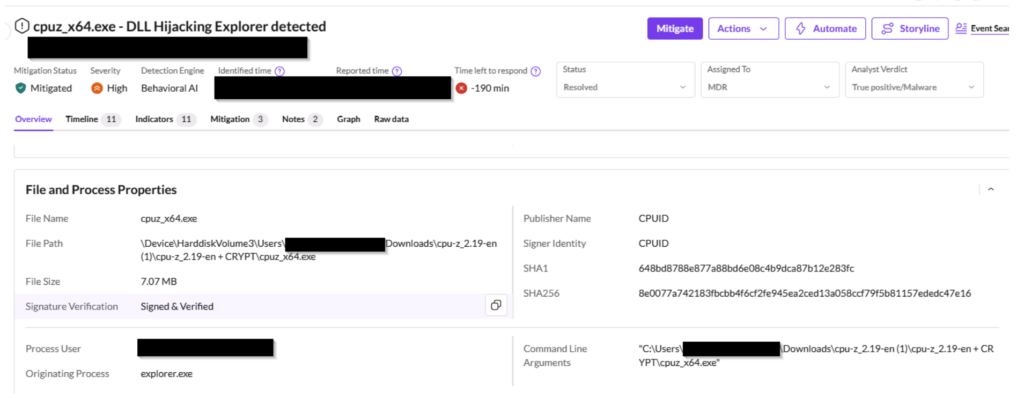
The attackers gained API-level access to the CPUID domain, allowing them to silently intercept download requests. When users clicked the official download button, they were redirected to malicious infrastructure. The downloaded file, cpuz_x64.exe, bore a valid digital signature and appeared identical to the legitimate version. However, upon execution, it initiated an abnormal process chain: spawning PowerShell, which then launched csc.exe (the C# compiler), followed by cvtres.exe. This chain is wholly atypical for CPU-Z, which never invokes these components during normal operation.
The Trust Chain Broken
CPU-Z and its sibling tools are staples in IT professionals' toolkits. Users followed every recommended security practice—downloading from the official vendor site, verifying signatures—yet the trust chain was severed at the supplier level. The attack exploited the implicit trust placed in software vendors, demonstrating that even legitimate distribution channels can become vectors for malware delivery.
The Growing Threat of Identity Subversion
GhostAction and NPM Campaigns
This incident aligns with a broader trend identified in SentinelOne's Annual Threat Report: attackers are shifting focus from exploiting software vulnerabilities to subverting trusted identities. In late 2025, the GhostAction campaign compromised a GitHub maintainer's account, injecting malicious workflows to exfiltrate secrets. Similarly, a phishing attack against an NPM package maintainer deployed code capable of intercepting cryptocurrency transactions. In both cases, commit logs and push events appeared legitimate because they originated from valid accounts with write access. The identity was verified, but the intent had been subverted. The CPUID attack extends this pattern to software distribution infrastructure itself.
SentinelOne's Behavioral Detection in Action
Five Indicators of Malicious Intent
SentinelOne's agent triggered the alert "Penetration framework or shellcode was detected" within the first seconds of cpuz_x64.exe execution. The detection relied on converging behavioral indicators rather than static signatures:
- Anomalous API resolution: The process located system functions through non-standard discovery methods, bypassing the OS loader entirely.
- Reflective code loading: Executable code ran from memory regions with no corresponding file on disk.
- Suspicious memory allocation: Read-Write-Execute (RWX) memory permissions were requested—a staging pattern for malicious payloads.
- Process injection patterns: Execution flow consistent with code being redirected into a secondary process to mask its origin.
- Heuristic shellcode signatures: Sequential operations characteristic of automated exploitation toolkits preparing an environment for command execution.
Autonomous Response and Containment
Upon detecting these anomalies, the SentinelOne agent autonomously terminated and quarantined the involved processes before the attack could advance further. The malicious payload, disguised as CRYPTBASE.dll and placed in the application directory (a classic DLL side-loading vector), was prevented from executing. The entire response occurred without human intervention, illustrating how AI-driven EDR can halt attacks at the earliest stages—even when the binary is signed and delivered from a trusted source.
Conclusion: Lessons for Supply Chain Security
The CPU-Z watering hole attack underscores a fundamental shift in the threat landscape: attackers are exploiting the trust placed in software vendors, their identities, and their distribution channels. Traditional security measures that rely on file reputation or signature matching are insufficient. Organizations must adopt behavioral detection and autonomous response capabilities that can recognize malicious intent regardless of the source's apparent legitimacy. SentinelOne's successful block of this attack demonstrates that AI-powered EDR provides the adaptive defense needed to counter supply chain threats—today and in the future.
Related Articles
- Windows Credential Crisis: New Approach Combines Access and Secrets Management to Stop Breaches
- Intuit Enterprise Suite vs QuickBooks Online: 8 Key Differences You Should Know
- Oracle Shifts to Monthly Security Patches in Race Against AI-Powered Cyber Threats
- Widespread Canvas Login Portal Defacements: Inside the ShinyHunters Extortion Campaign
- CopyFail Vulnerability: A Critical Linux Privilege Escalation Threatens Data Centers and Devices
- 10 Crucial Facts About Russia's Router Hack to Steal Microsoft Tokens
- 10 Shocking Facts About Russia's Router Hack to Steal Microsoft Tokens
- Braintrust Urges API Key Rotation Following AWS Account Breach