Revolutionary 3D-Printed Y-Zipper Lets Flat Materials Morph into Rigid Structures in Seconds
Breakthrough in Rapid Reversible Assembly
Researchers at a leading university have unveiled the Y-zipper, a 3D-printable mechanism that instantly transforms floppy 2D strips into strong, rigid 3D shapes. The invention, detailed in a recent study led by Jiaji Li, offers a reversible assembly method that could redefine portable structures and everyday objects.
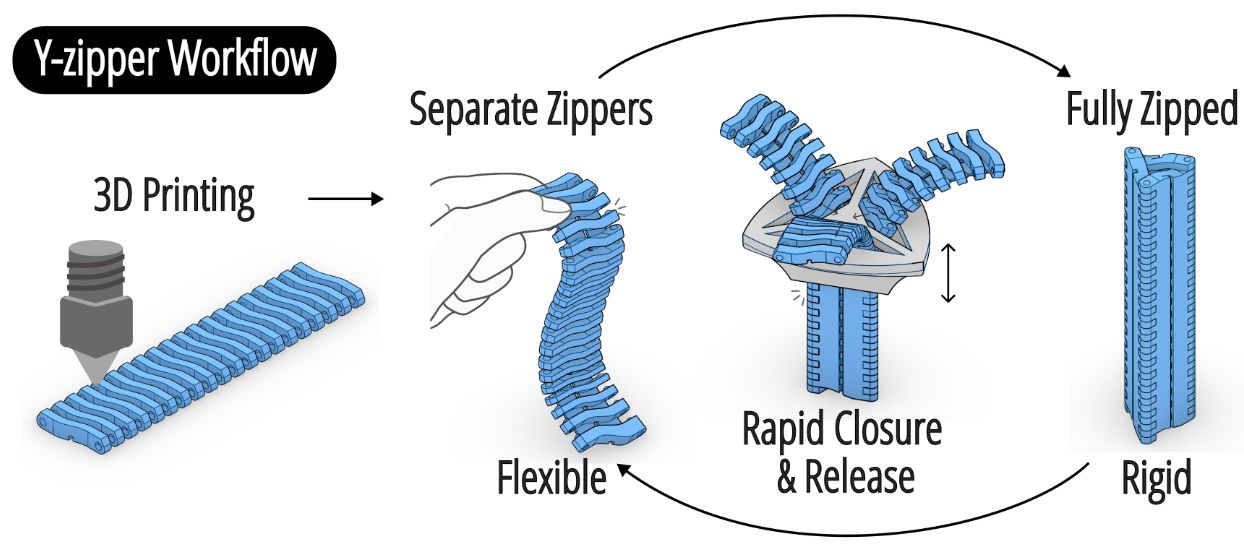
Unlike conventional zippers, which join fabric linearly, the Y-zipper integrates a curved tooth design that forces flat strips to bend and lock into complex geometries. The mechanism retains the ease of standard zipping while enabling automatic actuation and curved shapes.
“The Y-zipper fundamentally reimagines the zipper as a structural tool, not just a fastening device,” said Li, lead author of the study. “Our design allows users to go from a flexible sheet to a rigid column in seconds, simply by pulling a slider.”
The team demonstrated configurations ranging from helical coils to screw-like rods, all produced via standard fused deposition modeling (FDM) 3D printers. PLA and TPU filaments were used to create compliant bridges and fabric-integrated versions, showcasing versatility.
Background
The concept of using zippers for structural transformation is not entirely new, but earlier mechanisms lacked the ability to achieve curved geometries or automatic actuation. The Y-zipper addresses these gaps by modifying the basic straight tooth pattern into a Y-shaped interlocking system.
Key advantages include compatibility with 3D printing—allowing rapid prototyping—and the ability to join multiple Y-zipper rods through a joint design. This opens possibilities for modular assemblies that can be disassembled and reused.

“This is a clever extension of the classic zipper principle,” said Dr. Elena Voss, a materials engineer at MIT not involved in the research. “The integration of curved paths and reversible locking could lead to lightweight, deployable structures that are easy to transport and set up.”
The researchers estimate a maximum viable length of about 3 meters before the printed structures begin to disintegrate, due to material fatigue under repeated use.
What This Means
The Y-zipper could transform industries reliant on temporary rigid structures. Potential applications include pop-up tents, emergency shelters, medical braces, and deployable robotics. Its reversible nature means components can be collapsed flat for storage.
Compared to similar mechanisms like Velcro or snap-fit joints, the Y-zipper offers faster assembly and greater structural integrity. The team also demonstrated integration with fabric, paving the way for smart textiles that can change shape on demand.
“Imagine a tent that folds into a slim roll, then zips up into a rigid dome in under a minute,” Li added. “That’s the level of convenience we’re targeting.”
The next steps include scaling the design to longer lengths and exploring industrial-grade materials. With 3D printing becoming more accessible, the Y-zipper could soon find its way into consumer products.
Related Articles
- Chrome’s Gemini Nano Prompt API Launches Into Public Spotlight – On-Device AI Now a Single Call Away
- 10 Ways Docker and Mend.io Supercharge Your Vulnerability Management
- Understanding Dirty Frag: The No-Patch Linux Privilege Escalation Exploit
- Meta Enhances Security of Encrypted Backups with New Cryptographic Safeguards
- Why Enterprise Agent Security Needs Behavioral Integrity: The Tool Registry Blind Spot
- Revolutionizing Browser Security: How AI Uncovered Hundreds of Firefox Vulnerabilities
- When Your Learning Management System Gets Hacked: A Ransomware Response Guide (Inspired by the Canvas Incident)
- Russian State Hackers Hijack Aging Routers to Harvest Microsoft Office Tokens